
Reuse saves natural resources and reduces carbon dioxide emissions — not just in principle, but in measurable terms. The Renet network has developed a calculation method to demonstrate this concretely.
What is Renet?
Renet — Finland's reuse network — brings together flea markets, recycling centres and other reuse operators across Finland. The network's goal is to make reuse measurable, comparable and socially recognised activity.
The network develops shared calculation methods, shares information with its members and acts as a voice when the role of reuse needs to be strengthened in both legislation and public debate.
What does reuse concretely save?
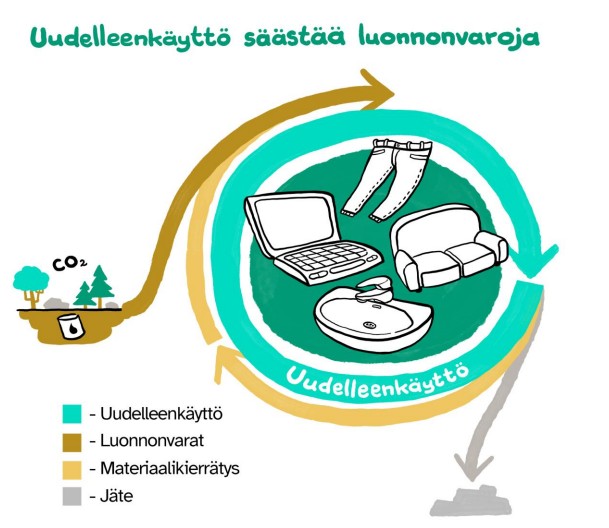
Manufacturing a new product consumes natural resources — minerals, fossil fuels, aggregates and raw materials from plants and animals. Consumption is often many times the weight of the product itself. At the same time, carbon dioxide emissions are generated.
When a used product changes hands, the equivalent manufacturing does not happen. Both natural resources and emissions are saved. This applies equally to a sofa, a winter coat, a bookshelf or a coffee maker.
Renet calculates the savings generated by its members' reuse annually. The calculation covers the sourcing and processing of materials contained in products — not product use or customers' trips to the store, since those are the same as for a new product.
Why is saving natural resources important?
According to researchers, overconsumption of natural resources is the single biggest driver of biodiversity loss. The more raw materials are mined, felled and processed, the more habitats disappear. Carbon dioxide emissions, in turn, accelerate climate change.
Reuse curbs both. When goods stay in use as long as possible, fewer new ones are needed — and both natural resources and the climate benefit.
How are savings calculated?
Renet has developed a calculation method in cooperation with Pääkaupunkiseudun Kierrätyskeskus Oy. Consumption of abiotic natural resources is based on Material Input calculations; carbon dioxide emissions on material carbon footprint estimates. The methods were developed with VTT among others, and they are externally validated.
The savings figures show how much natural resources and emissions one year of reuse has avoided. They do not represent an organisation's total carbon footprint, but they work well for sustainability communication alongside other environmental figures.
Toisen aarre as part of the network
We are a Tampere second hand department store built on reuse from the start. In our 1,000+ square metre shop on Papinkatu you'll find furniture, appliances, clothes, books, electronics and much more — all used, all carefully selected.
Renet membership means commitment for us: we want to be part of a broader change, not act alone. And we want our customers to trust that by making finds with us, they also do something measurable for nature.
Calculation: RENET Reuse Network in cooperation with Pääkaupunkiseudun Kierrätyskeskus Oy. Read more: renet.fi
Come make a find — and do something for nature. Papinkatu 20, Tampere.